Agent Sandboxing - Workshop on ARO
Welcome to the Agent Sandboxing workshop. In this hands-on session you will learn what the Red Hat build of Agent Sandbox is, see it in action running AI-generated code, demonstrate a real prompt injection attack, and then lock it down with OpenShift sandboxed containers (Kata Containers).
What is Agent Sandbox?
Red Hat build of Agent Sandbox provides developers with a programmable, Kubernetes-native API for running workloads in isolated environments, without requiring knowledge of the underlying sandboxing technology. Developers request a sandbox, and the platform delivers one. Whether OpenShift sandboxed containers (Kata Containers) or another runtime provides the underlying isolation, the platform administrator makes that choice — not the developer.
Despite its name, Agent Sandbox is not limited to AI agents. While it is a core component of the Red Hat agentic AI stack, it works equally well for any workload that benefits from sandboxed execution: development environments, notebook servers, code runners, build agents, or any application that requires complete isolation with instant provisioning.
|
Red Hat build of Agent Sandbox is available today on OpenShift Container Platform as a Technology Preview. General Availability is planned for November 2025. For background reading, see: |
Core advantages
Under the hood, Red Hat build of Agent Sandbox is a Kubernetes-native platform and a downstream build of the upstream kubernetes-sigs/agent-sandbox project. It delivers two core advantages:
Security with Kata Containers
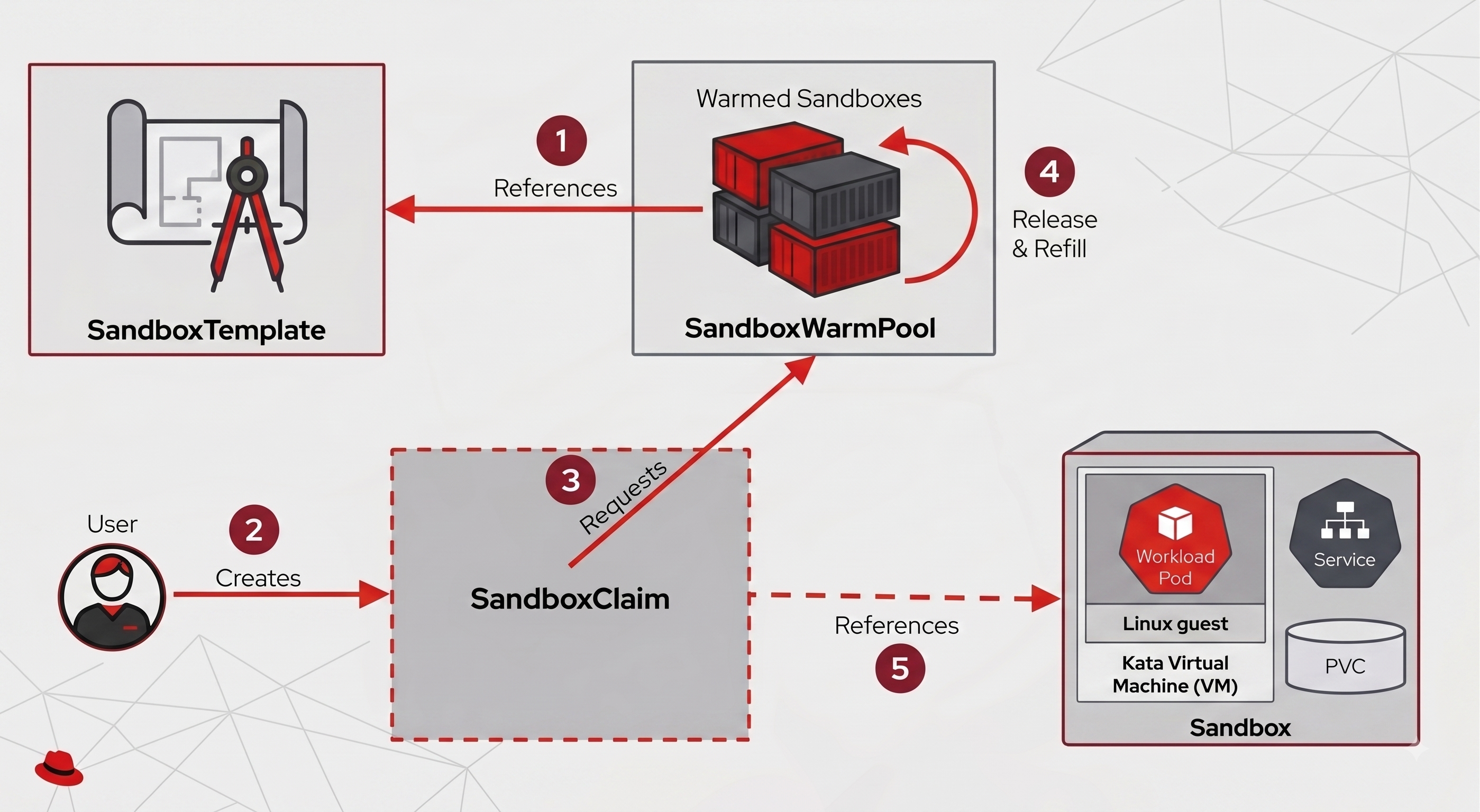
Agent Sandbox supports the Kata Containers runtimeClass, which allows sandboxes to execute within lightweight virtual machines (VMs). This provides a hardware-assisted isolation boundary. A platform administrator enables this by setting a single field in the SandboxTemplate — developers and end users are not affected because the API they use remains the same.
Speed with the Warm Pool
By maintaining a pool of pre-prepared environments, the system enables near-instant allocation of sandboxes in milliseconds, effectively eliminating traditional provisioning delays. When a sandbox is claimed, the warm pool releases a ready one and immediately starts provisioning a replacement.
The Sandbox CRDs
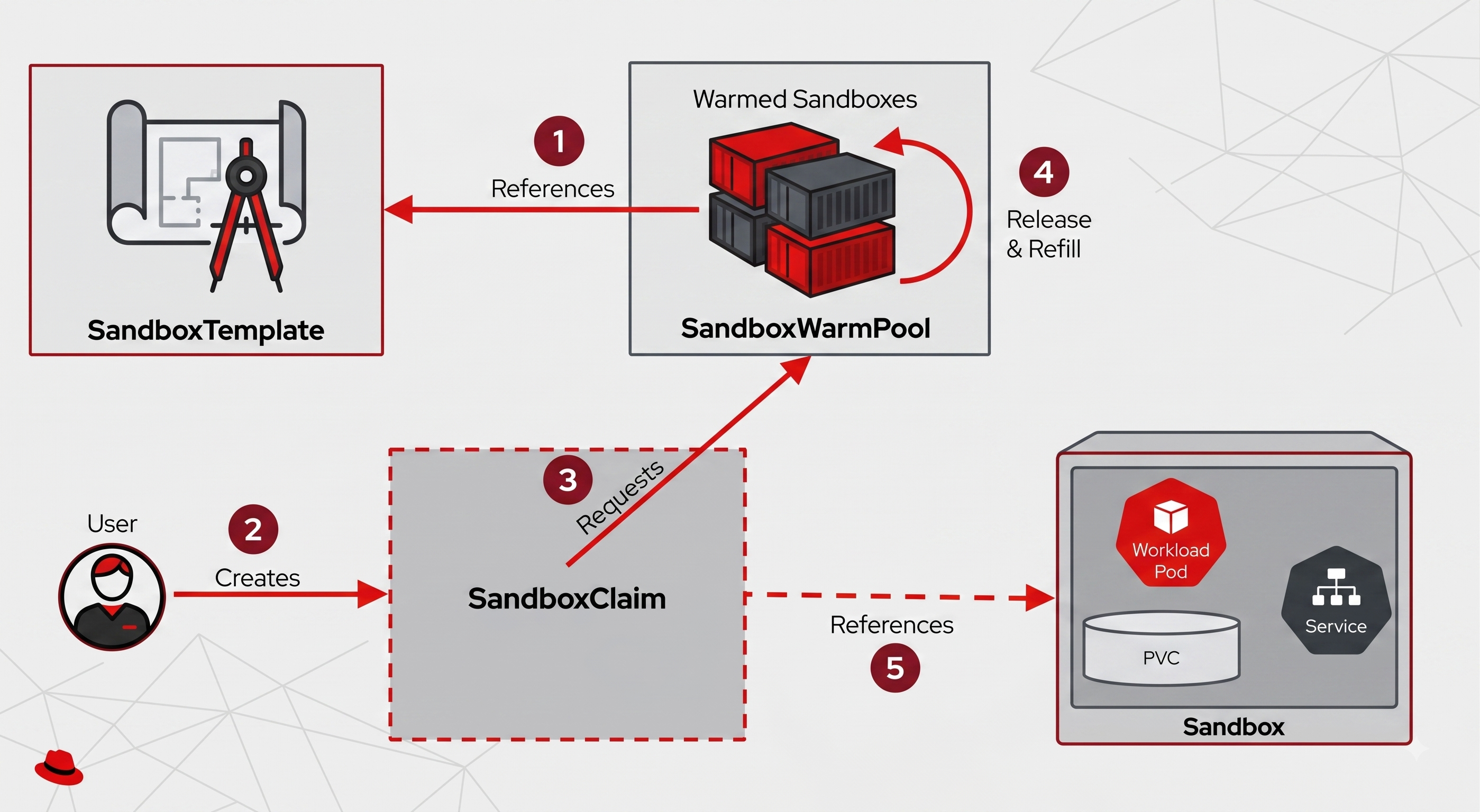
Red Hat build of Agent Sandbox introduces four primary custom resource definitions (CRDs) that work together:
-
Sandbox: The core resource — a single, stateful, long-running pod with stable identity. It can optionally include a service and a persistent volume claim (PVC). -
SandboxTemplate: A reusable blueprint that defines the Sandbox specification: container images, environment settings, and optionally theruntimeClassName(e.g.kata). -
SandboxWarmPool: Maintains a pool of pre-provisioned sandboxes based on aSandboxTemplate. Eliminates cold-start latency by keeping environments ready. -
SandboxClaim: Requests a sandbox from a warm pool. Once fulfilled, the claim points to the released sandbox and the pool replenishes itself.
The interaction flow:
-
The
SandboxWarmPoolreferences aSandboxTemplateto pre-provision sandboxes. -
The
SandboxWarmPoolpre-provisions one or multipleSandboxinstances ready to be claimed. -
A
SandboxClaimis created (either manually or by an application). -
The claim requests a ready
Sandboxfrom theSandboxWarmPool. -
The pool releases a
Sandboxand refills itself with a new one. -
The
SandboxClaimnow references the releasedSandbox.
When OpenShift sandboxed containers is enabled, the only change is that each sandbox pod runs inside a dedicated Kata VM:
Structure of this workshop
This workshop walks you through four modules:
-
The demo architecture — Understanding the components and how they fit together
-
Running LLM-generated code — Trying the demo hands-on
-
Prompt injection attack — Demonstrating why isolation matters
-
Isolating with Kata Containers — Locking down the sandbox with OpenShift sandboxed containers